01
You've shipped to real users, but your engagement, conversion, or retention metrics won't move, no matter how much you iterate.
02
You've done some user research, but you're not sure it told you anything you didn't already believe.
03
You know your users well (it's what got you this far), but you’re wondering how to graduate from instinct to evidence.
When the metrics stall, the instinct is to build more. The Market Fit Diagnostic does the opposite. Together we stop, and work out where the gap actually sits between what you're offering and what your users need, before you spend another sprint building the wrong thing.
In 4 weeks, you get:
Most importantly: You walk away with confidence in your path forward. Insight you can act on, not a document that lives in your cloud storage.
4 weeks. Fixed scope.
From £6,000.
Most founders start here.


"Working with Suzanne has been one of the most valuable partnerships in the evolution of our product. She has been a strategic thought partner and a critical force behind shaping the product. She consistently challenges thinking and raises the standard. Anyone who works with Suzanne can expect a true partner and, quite honestly, a unicorn talent."
— Kele Boakgomo, CEO, YuGrow
Find the real unmet need, build the offering around it, and prove it with evidence:
For a global health retailer reinventing around what customers actually wanted, I led the behavioural research (30 in-depth interviews + 750-person quant. study) and developed a new wellness proposition based on the learnings. The proposition anchored the investment case the board approved, which was then launched across web, app and store.
£700m+ in identified revenue potential across 14 markets.
For a UK bank out to grow its wealth business 250% in 5 years, I designed a mass-affluent investing proposition around the behavioural moments where human guidance actually shifts a customer's confidence, then led a live testing lab to keep sharpening it.
Assets under management doubled within 3 months of launch.
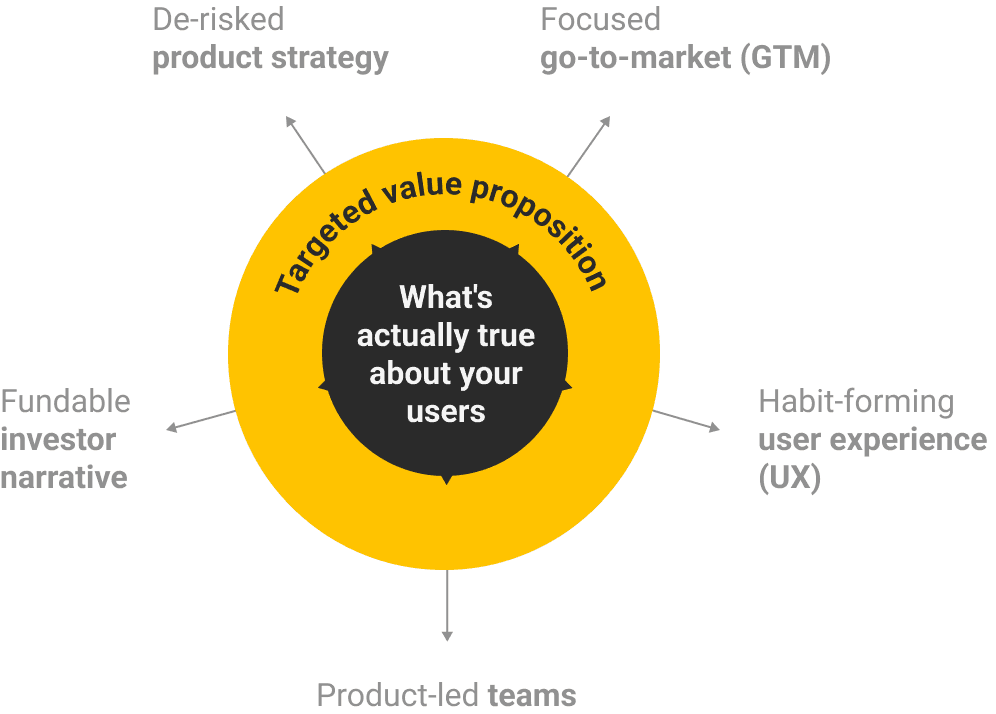
The diagnosis is where we start, not where it ends. Once you're clear on what your users actually need, it pinpoints far more than just a value proposition:
Almost every founder is accelerating their business with Claude, ChatGPT, or Gemini (or a combination of them all), and they should be. Used well, these tools are a real advantage. The founders creating the top 1% of products are the ones who know where the tools do their best work, and where the tools stop being enough, and a human read takes over.
Where I come in:
I read patterns across real companies
I've watched founders mistake their user for their buyer (and vice versa) and build towards the wrong answer. That kind of pattern recognition lives in experience, not training data.
AI optimises for being helpful inside the question you give it. It reflects your own framing back at you, which can feel like insight but often isn't. I help you check you're asking the right one, before you scale on a confident answer to the wrong thing.
If your interviews were leading or your survey asked the wrong people, AI will build on that shaky base quite happily. I'll flag and derisk it before it takes the weight of your whole product strategy.
You get the strategy, and someone who stays hands-on making it real. I don't hand over a diagnosis and leave you to work out delivery on your own. I stay close as the work ships and upskill your team as we go, so the strategy keeps paying off in your ways of working going forward.

Most startups die on an assumption that turned out to be wrong.
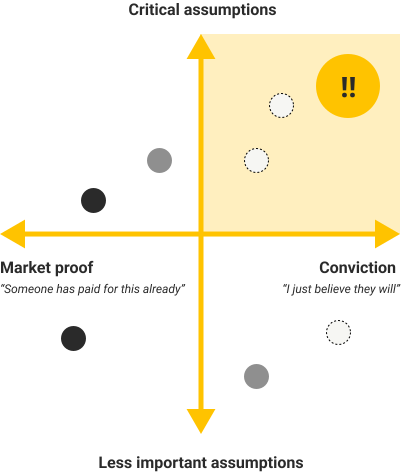
Premise is an independent stress test for your thinking, before you spend a year proving yourself wrong. In a short, guided conversation it pressure-tests the assumptions behind your product, and how strong your evidence for them actually is. You leave with a confidence score, a map of your riskiest assumptions, and a prioritised set of experiments to run next.

Why has my engagement gone flat after launch?
How is this different from product marketing?
Do you speak to our users?
I've already done research, testing and interviews. How is this different?
What will I actually leave with?